
Property Taxes
There are two types of ad valorem property taxes in Florida which are Real Estate Property and Tangible Personal Property. These tax statements are mailed out on or before November 1st of each year with the following discounts in effect for early payment:
- 4% if paid in November
- 3% if paid in December
- 2% if paid in January
- 1% if paid in February
Taxes become delinquent April 1st, at which time 3% interest plus advertising costs are added to the gross amount of the tax. For more information, visit our Delinquent Property Taxes Section.
The law allows taxpayers to pay their taxes on an installment plan if they so choose and if their estimated tax due is more than $100. For more information, visit our Installment Payment Plan Section.

Bill Express

The Charlotte County Tax Collector's Office now offers you the convenience of receiving your Tax Bill electronically. Sign up quickly by using the following steps:
- Click the Bill Express logo above or go to https://govhub.com/charlotte
- Choose your tax type and search for your account
- After finding your account, click "Get Bills by Email" button and fill out the form
Under Florida law:
- A discount period may not be extended due to a tax bill being returned as undeliverable electronically or by postal mail. (F.S.197.322)
- Email addresses are public records. If you register for electronic billing your email address may be subject to public record requests.
Real Estate Property Taxes
The Real Estate tax bill is a combined notice of ad valorem taxes and non-ad valorem assessments.
Ad Valorem Taxes are based on the value of real property and are collected in arrears on an annual basis beginning on or before November 1st for the tax year January through December. The Office of the Property Appraiser establishes the value of the property and the Board of County Commissioners, School Board, City Commissioners and other taxing authorities set the millage rates. A millage rate is the rate per thousand dollars of taxable value. To determine the ad valorem tax, multiply the taxable value by the millage rate and divide by 1,000. For instance, $100,000 in taxable value with a millage rate of 5.000 would generate $500 in taxes.
Using these values and allowing for exemptions, the tax roll is completed by the Property Appraiser. It is then certified to the Tax Collector who mails the tax notice/receipt to the owner's last address of record as it appears on the tax roll. However, it is the responsibility of each taxpayer to see that the taxes are paid and that a tax bill is received. In cases where the property owner pays through an escrow account, the mortgage company should request and be sent the tax bill, and the owner will receive a copy of the bill for information.
Non-ad Valorem assessments are based on factors other than the property value such as square footage or number of units. Levying authorities, such as stormwater utilities, fire and rescue, and solid waste are responsible for setting the non-ad valorem assessments. Some non-ad valorem assessments are paid in advance. Assessment periods vary. They may be calendar year or fiscal year.
If you receive a real estate tax bill for property you no longer own, please forward it to the new owner or return to the Tax Collector's Office.
Additional information about property taxes in Florida can be found on the FL Department of Revenue's website.
Tangible Personal Property Taxes
This is a tax levied against the furniture and equipment of a business or rental property. It also applies to structural additions to mobile homes.
The Property Appraiser's Office assesses the value of tangible personal property and presents a certified tax roll to the Tax Collector. It is the job of the Tax Collector to mail the tax notices and collect the monies due.
Tax bills for Tangible Personal Property are mailed at the same time as the Real Estate Tax Bills, and the same discounts apply. Taxes become delinquent April 1st, at which time 1.5% interest, plus a $2.00 late fee and advertising costs are added to the gross amount of tax. (See section on Delinquent Property Taxes).
Pursuant to Florida Statutes, Tax Warrants are issued prior to April 30th of the next year on all unpaid tangible personal property taxes. Within 30 days after the warrants are prepared, the Tax Collector applies to the Circuit Court for an order directing levy and seizure of the property for the amount of unpaid taxes and costs.
Installment Payment Plan
Taxpayers may choose to pay their real estate taxes quarterly by participating in an installment payment plan. To be eligible for the program, the taxpayer's estimated taxes must be in excess of $100.00. Those who qualify must fill out and return an Installment Plan application form to the Tax Collector's Office prior to May 1st (application forms are available at all county tax offices).
The plan requires that the first installment must be made no later than June 30th. Failure to make this first payment will automatically cancel the participant from the plan and the taxpayer will be required to pay the taxes due in full by March 31st.
Upon meeting the first installment deadline, the taxpayer is then obligated to participate in the program for the entire year. Discounts do not apply to delinquent payments. Any amount remaining unpaid on April 1st is treated as a delinquent tax bill.
- 1st Installment - 1/4 the total estimated taxes discounted 6%. Due by June 30
- 2nd Installment - 1/4 the total estimated taxes discounted 4.5%. Due by September 30
- 3rd Installment - 1/4 the total estimated taxes plus 1/2 of any adjustment made for actual tax liability discounted 3%. Due by December 31st
- 4th Installment - 1/4 the total estimated taxes plus the remaining 1/2 of any adjustment for actual tax liability. No discount applies. Due by March 31st
Taxpayers participating in the installment payment plan are automatically re-enrolled each year and do not have to fill out a new application. If you wish to be removed from the installment plan once enrolled, simply disregard the June tax bill. This will automatically remove you from the plan. You will then receive a bill in November for the gross amount.
Tax Bill Information
Use this guide to understand each section of your Charlotte County property tax notice. Each numbered marker below corresponds to a section of the sample tax bill shown on this page. If you have additional questions please contact us at (941) 743-1350 or taxcollector@charlottecountyfl.gov.
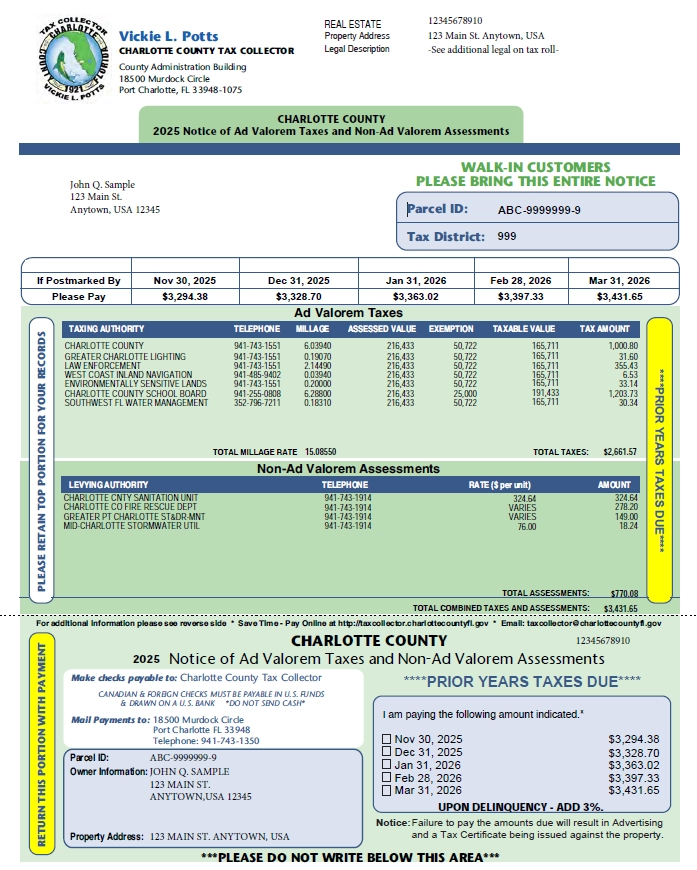
Sample tax bill for illustration purposes only. Your bill will reflect your property’s specific information.
-
Parcel ID
This is a unique number assigned to each property.
-
Notice of Delinquent Taxes
If this area shows PRIOR YEARS TAXES DUE, delinquent taxes are owed on this account. See the important information on the back of your tax notice for more details.
-
Assessed Value
This is the value assigned to your property for tax purposes. For questions about your property’s assessed value, please contact the Charlotte County Property Appraiser’s Office at (941) 743-1498.
-
Exemption
Exemptions reduce the taxable value of your property, which lowers the amount of taxes you owe. For questions about exemptions on your tax notice, please contact the Charlotte County Property Appraiser’s Office at (941) 743-1593.
-
Total Taxes
This is the combined total of all Ad Valorem and Non-Ad Valorem taxes. No discounts have been subtracted from this amount. Refer to the payment schedule at the top of your bill or on the payment stub to pay the correct discounted amount.
-
Payment Stub
Remove this portion and return it with your payment in the envelope provided. Early payment discounts are available.
Current Tax Forms and Files
- Current Real Estate Property Tax Roll
Instructions: Click on the above link. Choose "Current Real Estate Roll" from the menu, enter your search criteria, and hit the "Enter" key.
Please note: The report may take some time to load, depending on your Internet connection.
Download Instructions: The file can be downloaded in a number of formats by clicking one of the icons on the right hand side of the page beside the word "download" - Current Tangible Property Tax Roll
Instructions: Click on the above link. Choose "Current Tangible Roll" from the menu, enter your search criteria, and hit the "Enter" key.
Please note: The report may take some time to load, depending on your Internet connection.
Download Instructions: The file can be downloaded in a number of formats by clicking one of the icons on the right hand side of the page beside the word "download"
- Application for Homestead Exemption
This link will redirect to the Charlotte County Property Appraiser's website - Homestead Property Tax Deferral Act
Florida Statutes regarding the Homestead Property Tax Deferral Act
For questions about eligibility for Homestead Property Tax Deferral please call (941)743-1350 - Charlotte County Community Development Certificate of Use Form
- Installment Payment Plan Notice and Application
Please mail completed form to:
Charlotte County Tax Collector
18500 Murdock Circle
Port Charlotte, FL 33948 - Application for Refund of Ad Valorem Taxes
DR-462 provided by FL Department of Revenue